New to Clairwave? Start with the illustrated guide, or find a quick answer below.
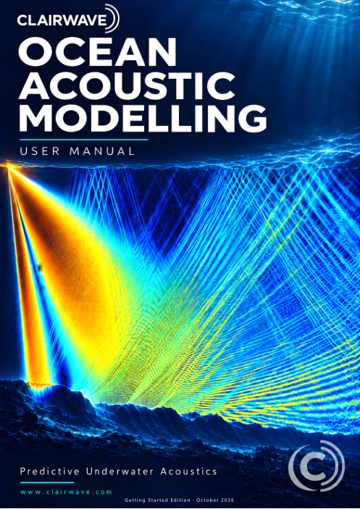
Getting Started Guide
Fifty illustrated pages: signing in, a tour of the screen, the globe, flat map and terrain, your first simulation in ten minutes, and connecting your AI assistant. Free to read, no account needed.
Premium users download the complete User Manual (about 240 pages, every control, five worked examples) from the Account panel in the app.
What does Clairwave do?+
Clairwave predicts how sound travels underwater, anywhere on Earth, in your browser. You choose a place, a sound source and a frequency, and Clairwave returns a 3-D picture of how loud that sound is at every range, depth and bearing. It also estimates the noise of real ships, the ambient noise from wind and rain, and how far away a hydrophone or sonar can pick up a sound.
Do I need to install anything?+
No. Clairwave runs in a current Microsoft Edge, Google Chrome, Mozilla Firefox or Apple Safari with WebGL 2. It works on integrated graphics, and a dedicated graphics card keeps the 3-D view smooth. Phones and tablets get a simplified layout. If the globe stays black, turn on hardware acceleration in your browser settings.
Do I need an account?+
No. Click Launch Clairwave, then Continue as guest to try it straight away. A free account keeps your sign-in across visits. Premium features need an account.
What is included for free, and what does Premium add?+
Free and guest users run the RAM, Bellhop and OAST solvers out to 10 km at 200 Hz, with seasonal sound-speed profiles, live ships around Gibraltar and a 48-hour weather forecast. Premium removes the range and frequency limits and adds the GPU solvers, the 10-day GIOPS ocean forecast, custom sound-speed profiles, live ships worldwide, a 15-day weather forecast and reverberation. See Plans & Pricing.
How accurate are the predictions?+
Clairwave uses established, peer-reviewed propagation models with real bathymetry, ocean sound speed and seabed data for the place you pick. Its ship-noise estimates are compared with hydrophone recordings; you can explore the results in Live Validation. Treat the output as a model prediction for planning and screening, not as a measurement.
Where does the ocean data come from?+
Clairwave combines global GEBCO bathymetry, seasonal ocean climatology, the GIOPS 10-day ocean forecast, seabed sediment maps, weather forecasts and live AIS ship positions. You never have to find or load these yourself: pick a place and Clairwave fetches them.
Can I save or share my results?+
Yes. Every plan can export an HD picture of the vertical slice, a ray-sweep video and the run settings. Premium adds cross-device profile sync, so your working area follows you between devices. Runs started from an AI assistant come with a link that opens the result in Clairwave.
Can I use Clairwave from ChatGPT, Claude or Grok?+
Yes. In ChatGPT, open Plugins, search for Clairwave and click +. In Claude or Grok, add https://www.clairwave.com/mcp as a custom connector. Then ask in plain language. No Clairwave account or API key is needed. See AI Assistants for the steps.
How do I upgrade or cancel?+
Sign in, open your Account window and click Upgrade to Premium; payment runs through secure Stripe checkout. Manage subscription in the same window lets you change your card, download invoices or cancel.
Can my organisation run Clairwave on its own hardware?+
Yes. The Enterprise plan installs Clairwave on your own or national hardware, including air-gapped networks, with training and in-service support. Contact us to book a demo.
Where can I get help?+
Start with the Getting Started Guide (PDF), which ends with a troubleshooting chapter. For anything else, write to [email protected].

 Claude — Settings › Connectors › Add custom connector
 ChatGPT — Plugins › search “Clairwave” › + (no URL, no developer mode)
 Grok — grok.com/connectors › New Connector › Custom